11 min to read
Map Writing Vol.2|穿过石窗,是地图的漏洞·牵挂的经纬
手电的光束在石窗里探了又探,像卫星无法识别地球的深度。
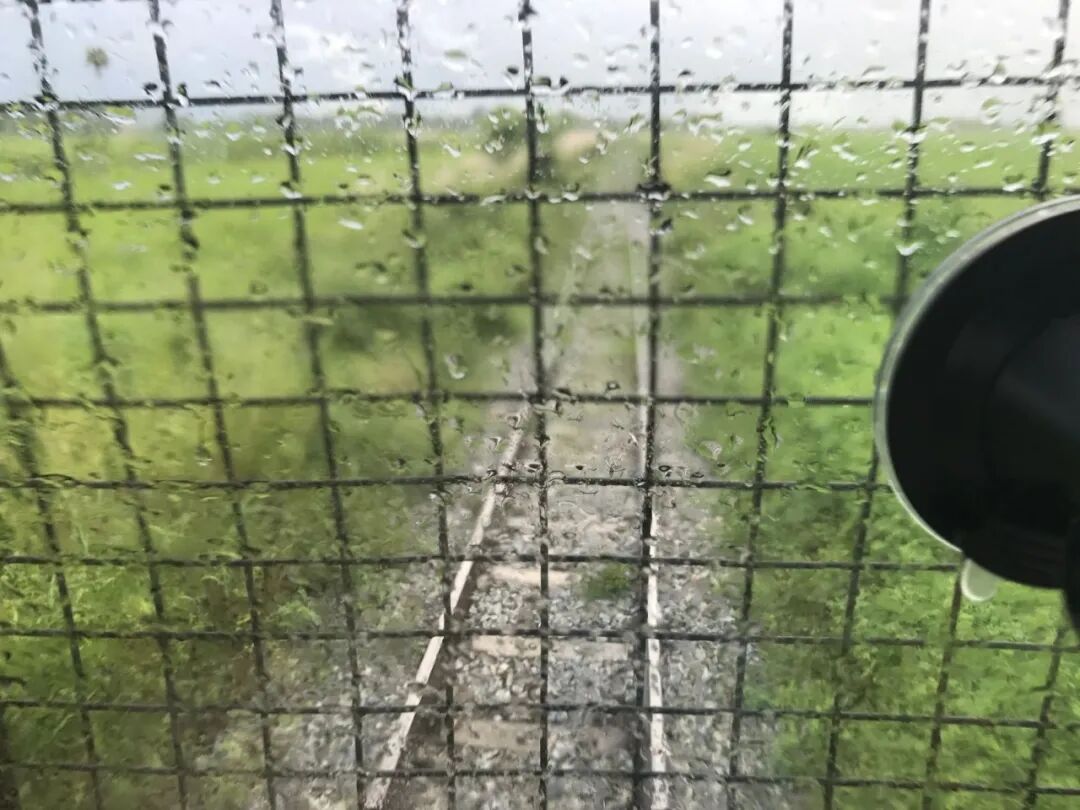
按语:雨密密匝匝地敲在矿区的铁皮屋顶上,先是针般的细响,渐渐汇成压塌空气的鼓点。进入雨季,一些矿坑就变成了湖。
几十年的机械化掘挖,把山体掏空成巨大的盆地。每到雨季,缅甸军政府认证的“合法矿企”会撤走重型机械,将矿区短暂“归还”给大家。
2020年7月2日,在缅甸克钦邦帕敢的一个矿坑,暴雨浑浊了湖水,也松动了山体。泥石轰然坠入湖中,卷起六米高的浪,不到一分钟,至少一百七十五条生命被吞没——那些在矿企撤离后,才有机会进入矿场捡拾尾矿、寻找生计的人们。这是缅甸有史以来伤亡最惨重的矿难,也是不计其数的矿难之一。
在 Google Earth 上,这些矿坑永远光滑、干净,是没有阴影的色块。作者 Jing 穿过一连串地理坐标与个人轨迹,进入缅甸北部翡翠矿区,探照那些被“抹平”的地方,寻找“最大限度地分解”与“最大程度地保持模糊”之间的缝隙,犹如用手电刺入玉石的小窗。
这是《牵挂的经纬》缅甸地图写作工作坊的第二期作品,继续从具体地点的细节出发,拼合看似分散的影像、物件与人事。
I, 没有云的世界和开一个小窗的石头
I. A World Without Clouds and the Stone with a Small Window
Google earth制造了一个万里无云的世界,在这里面俯瞰地球会忘记有云的存在。Google公司通过各种算法,用大量消除云层之后的图像碎片拼接出一个清晰的地球。
从识别遮盖物,剥离遮盖物,到“呈现出下面的东西”,之间有大量的工作,它们形成一个机器和人在里面共同忙碌的空间,支撑着屏幕里“地球”的图像呈现。
缅甸的翡翠也在一个围绕着“剥离遮盖物”形成的多层空间里。缅甸北部的山被剥开,机器和人不分日夜翻找翡翠原石;在一颗原石的“壳”与下面被称作“玉”的部分之间,是商人开的一个小窗,买家举着高亮度的手电对着小窗反复侦查,评估遮盖物下的价值。
有的石头就停留在这个阶段,不愿冒险的商人会最大限度保留粗燥外壳与小窗之间的张力所拉扯出来的幻想空间,在商人间转手,外壳不再被剥离,也许这就是它市场价值最高的时刻。
翡翠层层剥离不是为了透明,从矿山到玉器,更像是人为了榨干每一层的经济价值而剥离,许多模糊不清的规则在背后驱动和决定其价值。
在缅甸挖出的翡翠中,绝大部分最终走私到了中国。我一直认为“玉”不是一种具体的材料,更多是一个中国的文化概念,它的物质性从来都不清晰,然而颜色艳丽的缅甸翡翠因为中国的玉文化而获得较高的市场价值。我出生的中国云南省和缅甸相邻。从小以来的认知里,翡翠就是一种真假难辨,价值飘忽不定的东西。小时候爷爷奶奶家在地矿局,大门口有很多矿石与珠宝店铺,里面陈列着昂贵的翡翠,但同时附近不远的花鸟市场里,有很多便宜的翡翠,它们都一样的鲜绿。无论是哪种商店,卖家总会拿出一个小手电筒照着翡翠,说出一堆术语。大人之间也常常会聊到关于翡翠的故事,受骗经历,倾家荡产,被做局,认识内部人士,这些和他们多年后讨论股市或者金融产品的话题都大同小异。
从石头里面剥离出的“玉器”,相较于围绕着钻石建立的权力体系,主要由中国人对翡翠的审美来定价,并无一套明确的规范,代表顶级翡翠的“帝王绿/Imperial green”更像是父权社会里拥有寓意的某种视觉感受。“种水色工地瑕”这几个代表着翡翠标准的术语背后都有很大的解释/演绎空间。行内经验与行话构成的壁垒也并非一尘不变,人们同时在不断发明新的黑话和形容词,堆成新的壁垒,获得影响价格的权力。
Google Earth has created a world without clouds—a place where, from above, one forgets that clouds ever existed. Through various algorithms, Google stitches together a clear image of the Earth from countless fragments of cloud-free satellite photos.
Between identifying what’s covering, peeling away what’s covering, and “revealing what lies beneath,” there is an immense amount of work. These actions form a space where machines and humans labor together, sustaining the illusion of “Earth” on the screen.
Jade in northern Myanmar exists within a similarly layered space, constructed around the act of “removing what covers.” The mountains of northern Myanmar are peeled open; machines and people, day and night, search tirelessly for jadeite boulders. Between the “shell” of a boulder and the inner part referred to as “jade,” merchants carve open a small window. Buyers, with high-powered flashlights, peer repeatedly into this window, attempting to assess the value that lies beneath the surface.
Some stones remain at this stage. Risk-averse traders preserve the tension between the rough exterior and the small window for as long as possible, holding onto the fantasy space that tension produces. The stone changes hands among merchants, the shell left intact—perhaps this is when its market value is at its peak.
The layers of jade are not peeled away in pursuit of transparency. From the mine to the finished object, the peeling is more about extracting every bit of economic value. Many vague and obscure rules operate in the background, shaping and determining its worth.
Of the jade unearthed in Myanmar, the vast majority is eventually smuggled into China. I’ve always believed that “jade” is not a specific material but more a cultural concept in China—its materiality is never clearly defined. Yet, Myanmar’s brightly colored jadeite gains high market value precisely because of this Chinese jade culture. I was born in Yunnan Province, China, which borders Myanmar. Since childhood, jadeite has always been something hard to authenticate, its value uncertain and ever-shifting. My grandparents lived near the Bureau of Geology and Mineral Resources. Outside its gate were many shops selling stones and gems, with expensive jadeite on display. Yet just a short walk away, in the local flower-and-bird market, cheap jadeite was everywhere—just as vividly green. In any shop, the seller would take out a small flashlight and shine it on the jade, speaking in a flurry of jargon. Adults often told jade stories—of being scammed, losing everything, getting trapped in elaborate setups, or knowing someone on the inside. These stories would later echo their conversations about stocks and financial products.
The “jade objects” carved from these stones are priced largely according to Chinese aesthetics, unlike the diamond industry with its clear power structures and formal standards. The term “Imperial Green,” which denotes top-grade jadeite, feels more like a visual sensation infused with patriarchal meaning. The standard jade terminology—zhong, shui, se, gong, di, xia (texture, translucency, color, craftsmanship, background, flaws)—carries ample room for interpretation. The insider knowledge and coded language that form the industry’s barriers are not static. People are always inventing new slang and descriptors, building fresh walls to gain control over pricing power.
Imperial Green (帝王绿), Zhengyang Green (正阳绿), Spicy Green (辣绿), Emerald Green (翠绿), Scallion-Heart Green (葱心绿), Apple Green (苹果绿), Floating Flower Green (飘花绿), Bean Green (豆绿), With Spring Tint (带春), Oily Green (油青), Bluish Green (蓝绿), Yellow-Green (黄绿), Lavender (紫罗兰) Yellow Fei (黄翡), Fei Yellow (翡黄), Ginger Yellow (姜黄), Honey Yellow (蜜糖黄), Chicken Fat Yellow (鸡油黄) Glutinous Jade (糯种), Icy Jade (冰种), Glass Jade (玻璃种), Bean Jade (豆种), Cotton (棉) Window Opening (开窗), Polished Spot (擦口), Full Gamble Rough (全赌料) Sand Removal (脱沙), Jade Revealing (起货), Shell Removal (脱壳) Water Head (水头), Light Reflection (起光), Gel-like Glow (起胶), Mist-like Sheen (起雾), Crack (裂), Impurity (脏) Color Root (色根), Color Band (色带), Misjudgment (看走眼)
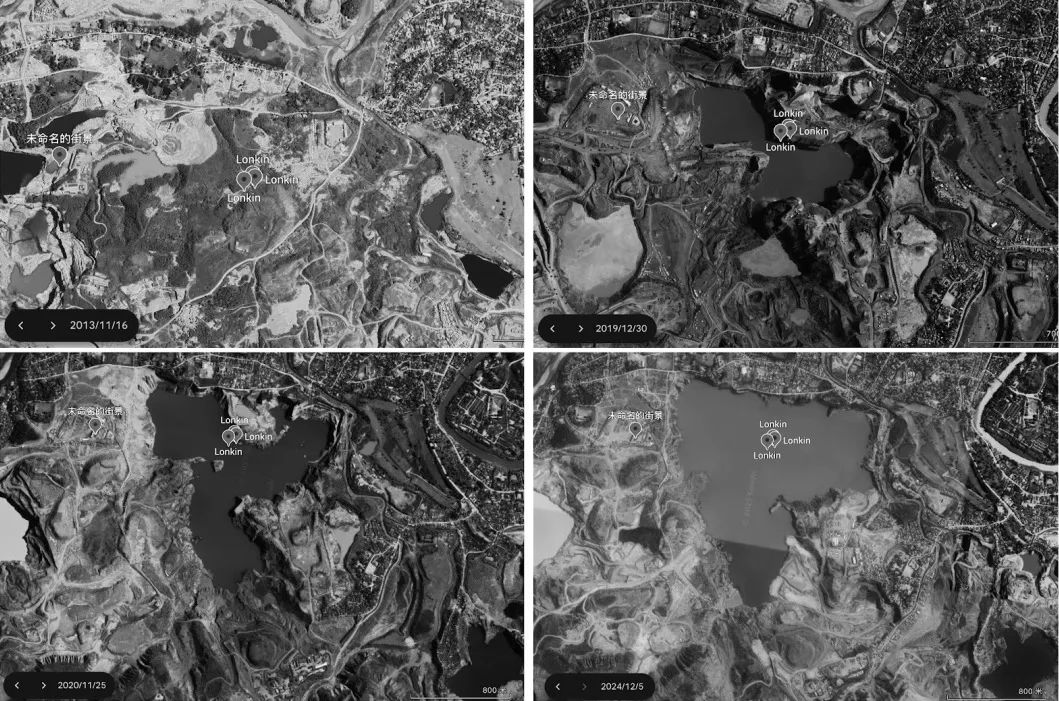
Caption: This is the jade mining area named Lokin, located in Hpakant Township, Kachin State, northern Myanmar. The images show its transformation from 2013 to 2024.
我最初以为是湖水的位置,其实是卫星无法识别其深度的矿坑。
同时在缅甸的矿区,发放挖矿许可的收入,混乱的税收,贿赂,成为了这些武装力量的金库:缅甸国防军(Tatmadaw, 缅甸军方)、克钦独立军(Kachin Independence Organisation/Army , 简称 KIO/A)、佤邦联合军(UWSA/P),缅甸民族民主联盟军(Myanmar National Democratic Alliance Army)和若开军(Arakan Army),以及其他小的边防部队。他们围绕着矿区有时混战,有时合作,互相用玉石交换武器。
“克钦邦当地居民几乎没有享受到玉石业带来的经济利益。” —《玉石与冲突:缅甸的恶性循环》global witness/全球见证,2021年6月
What I initially thought was a lake is, in fact, a mining pit whose depth cannot be detected by satellite.
At the same time, in Myanmar’s mining regions, revenues from mining permits, chaotic tax systems, and bribery have become a cash reserve for various armed groups: the Myanmar military (Tatmadaw), the Kachin Independence Organisation/Army (KIO/A), the United Wa State Army/Party (UWSA/P), the Myanmar National Democratic Alliance Army, the Arakan Army, and other smaller border forces. Around the mining zones, they sometimes clash, sometimes collaborate—trading jade for weapons with one another.
“Local residents in Kachin State have benefited little from the jade industry’s economic gains.”
— “Jade and Conflict: Myanmar’s Vicious Circle,” Global Witness, June 2021.
II,在互联网的石堆里翻刨
II. Digging Through the Pile of Stones on the Internet
1, 矿区仓库和修理师
- Warehouse and Repairmen in the Mining Area
在google earth里能看见云和天气的地方是街景模式。
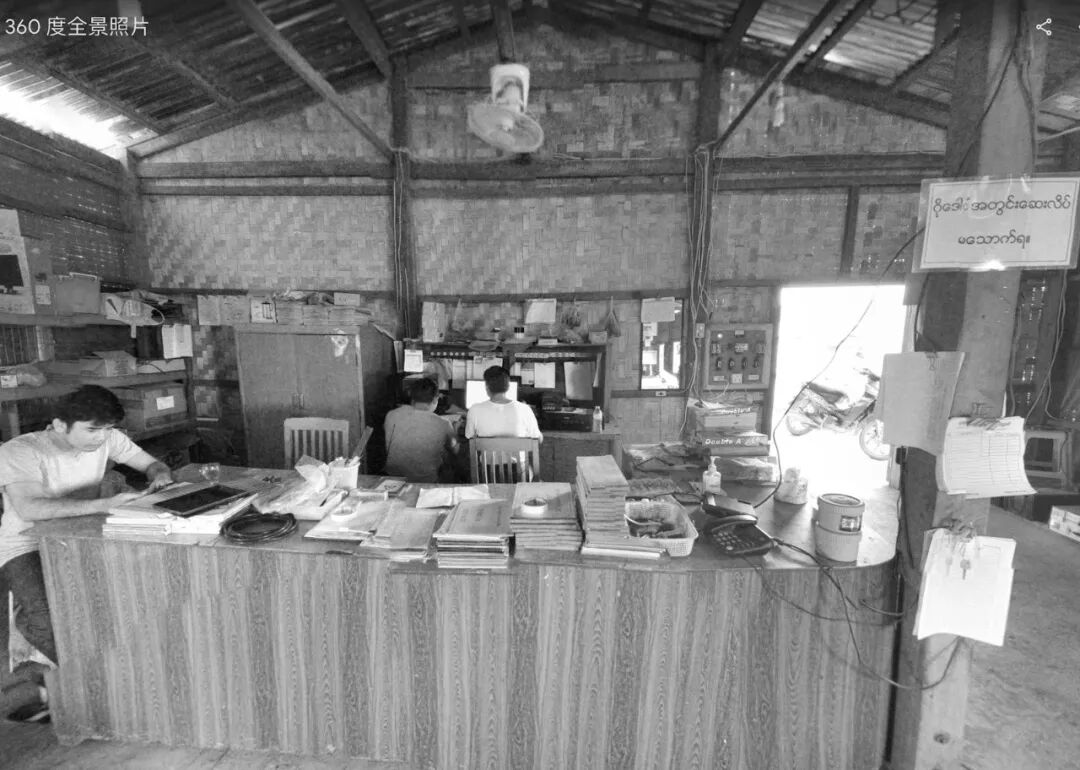
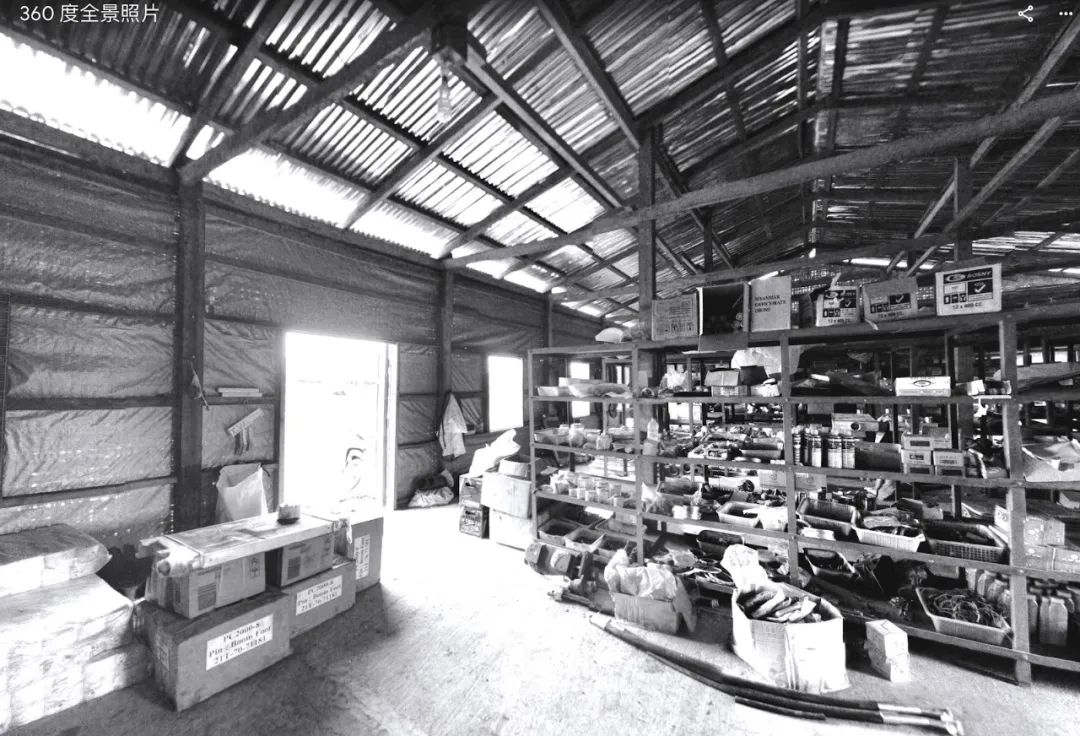
我钻进了一个推测在2019年建立的帕敢翡翠矿区的仓库里。这里是一个管理工人,办公耗材,修理工具,仓储机械零件的地方。
The only place where you can still see clouds and weather in Google Earth is in Street View mode.
I slipped into what appears to be a warehouse built around 2019 in the Hpakant jade mining area. This is a space for managing workers, office supplies, repair tools, and storing mechanical parts.
在浏览过每一个能企及的细节以后,我更好奇一个什么样的人会上传整个办公室和仓库的照片到google map里。这张全景图上传于2020年6月,当时由昂山素季领导的全国民主联盟(National League for Democracy,简称民盟)还是执政党。没花多少力气,我就发现发图者是一个在网络上习惯使用真名,对个人信息的比较粗心的小修理厂老板。我甚至在某个图片里看到了他的护照号。
社交媒体上他标注的生活轨迹与我这次查看缅甸地图的顺序奇怪的重合了,他出生和成长在实皆Sagaing — 今年(2025年)缅甸大地震的中心,曾住在翡翠矿区帕敢Hpakrant —仓库所在地,现在生活在曼德勒Madeley — 缅甸最大的翡翠交易市场所在地。
在其中一个社交平台上他热衷记录女儿的成长,同时穿插了各种修理案例,涵盖修理各种挖掘机的电机电路,安装修理空调,冰箱等。我也好奇观察这个仓库是否有空调,只看到一个固定在梁上的电风扇,墙面由编织竹板,塑料布,和铁丝网构成,顶棚是单层的金属瓦楞板,地面是粗糙的水泥 — 我明白过来,这些物品组成了google earth里的“天气”与温度,我正在观看一个炎热的仓库,还可以想象下雨时单层金属板屋顶发出的高声贝响声。
看见和知道看见了什么,之间差距很大。
在浏览了大部分他贴出来的修理案例后,才逐渐理解了这个仓库里一些东西的潜在关系:电焊机,焊条,发动机冷却器散热器,发动机过滤网。
和那里的工人一样,发动机也受到过热和大量粉尘的困扰。
After examining every accessible detail, I became more curious about what kind of person would upload full photos of an office and warehouse to Google Maps. This panoramic image was uploaded in June 2020, when the National League for Democracy (NLD), led by Aung San Suu Kyi, was still in power. It didn’t take much effort to discover that the uploader was a small repair shop owner who regularly used his real name online and was rather careless with his personal information. In one of the photos, I even saw his passport number.
Strangely, the path of locations marked on his social media closely mirrored the sequence in which I had been browsing the map of Myanmar. He was born and raised in Sagaing — the epicenter of Myanmar’s devastating earthquake in 2025 — had lived in Hpakant, the jade mining town where the warehouse is located, and now resides in Mandalay — the country’s largest jade trading hub.
On one social platform, he eagerly documents his daughter’s growth, interspersed with various repair cases, ranging from excavator motor circuits to air conditioner and refrigerator repairs. I also found myself wondering whether this warehouse had air conditioning. All I saw was a fan fixed to a beam. The walls were made of woven bamboo panels, plastic sheeting, and wire mesh; the roof was a single layer of corrugated metal; the floor, rough concrete. I realized: these materials are what compose “weather” and temperature inside Google Earth—I was looking at a hot warehouse, and could imagine the deafening sound that roof would make in heavy rain.
There is a wide gap between seeing and knowing what you’ve seen.
Only after going through most of his repair documentation did I begin to understand the potential relationships between certain objects in the warehouse: welding machines, electrodes, engine coolers, and engine filters.
Just like the workers there, the engines suffer from overheating and heavy dust.
2, 感受一台挖掘机的尺度
2 . Sensing the Scale of an Excavator
仓库里各种箱子上最清楚的信息,大概是这里:
The clearest information visible on the various boxes inside the warehouse is probably this:
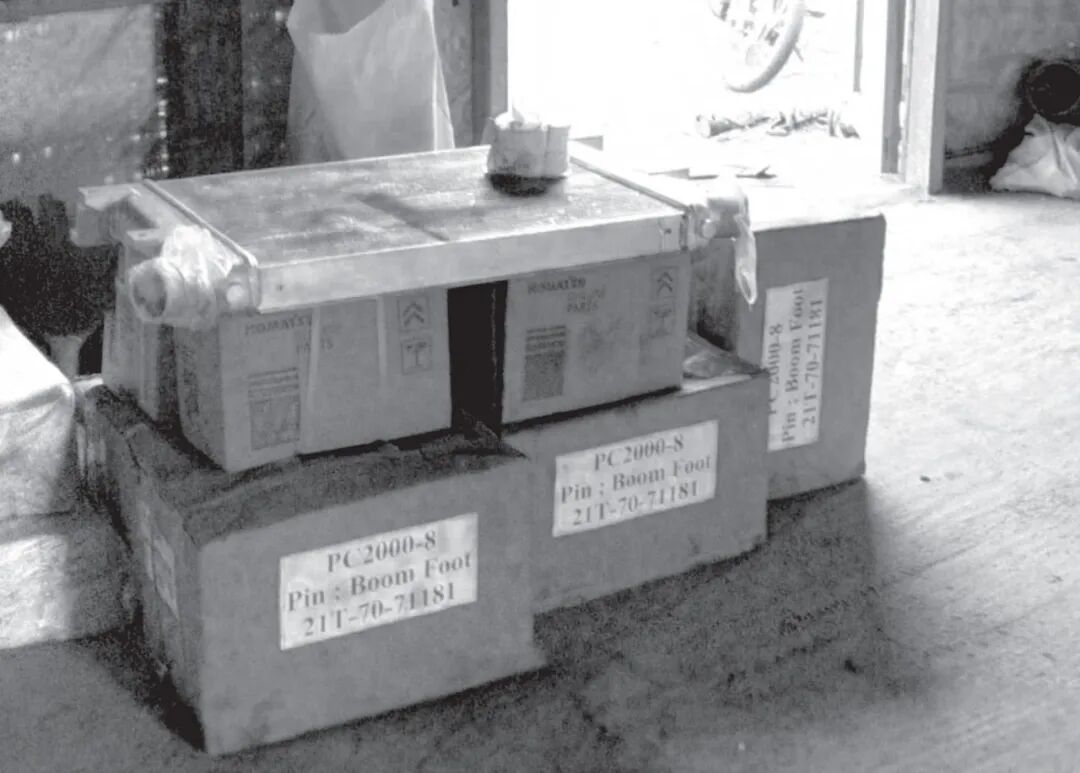
我在阿里巴巴上搜到了这款零件,明白了这个矿区用的挖掘机型号。
PC2000-8:小松(Komatsu)超大型液压挖掘机型号;
Pin: Boom Foot:这是连接动臂(Boom)底部与机身旋转平台之间的枢轴销(pin)属于挖掘机主结构核心部件;
编号“21T-70-71181”为 小松 Komatsu 原厂编号。
什么是“超大型”液压挖掘机?看产品的数据或者卫星图上的俯瞰照片都不能给我一个直观的感受。而在修理师拍摄的孩子与Komatsu PC2000挖掘机的合影里,我感受到了它的尺度。
I found this part on Alibaba and identified the excavator model used in this mining area.
PC2000-8: A super-large hydraulic excavator model by Komatsu.
Pin: Boom Foot: This refers to the pivot pin that connects the base of the boom to the excavator’s rotating platform—a core structural component.
Part number “21T-70-71181” is a genuine Komatsu part number.
But what does “super-large” mean when it comes to hydraulic excavators? Product data sheets or satellite-view photos don’t really give me a visceral sense.
It was in a repairman’s photo of his child standing beside a Komatsu PC2000 that I truly felt its scale.
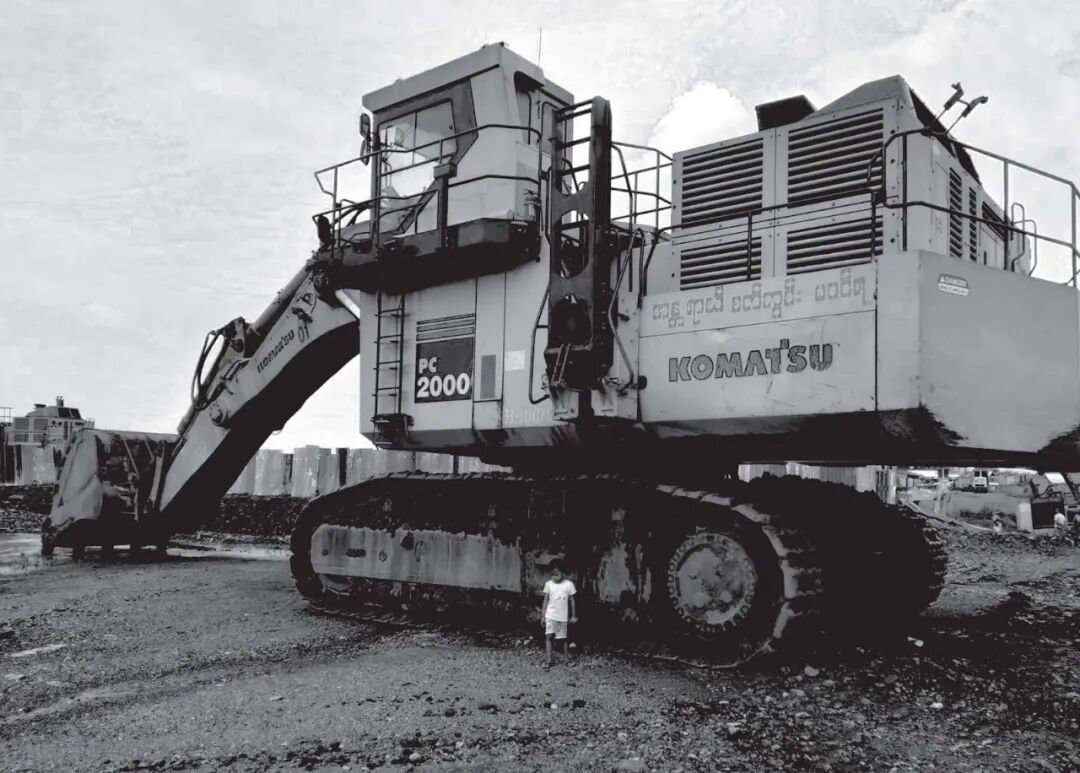
Caption: The repairman’s child posing with a Komatsu PC2000 excavator
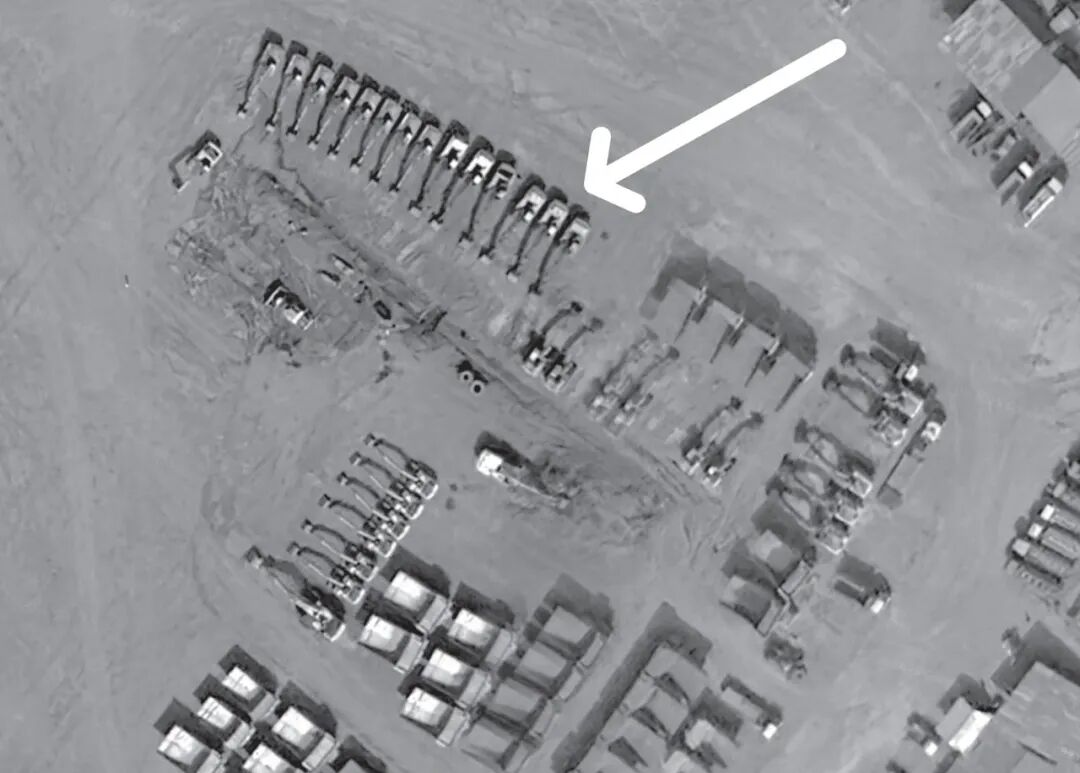
Caption: The excavator parked outside the warehouse, seen from satellite imagery
3, London tissue卫生纸和头戴灯
3 . London Tissue Toilet Paper and Headlamps
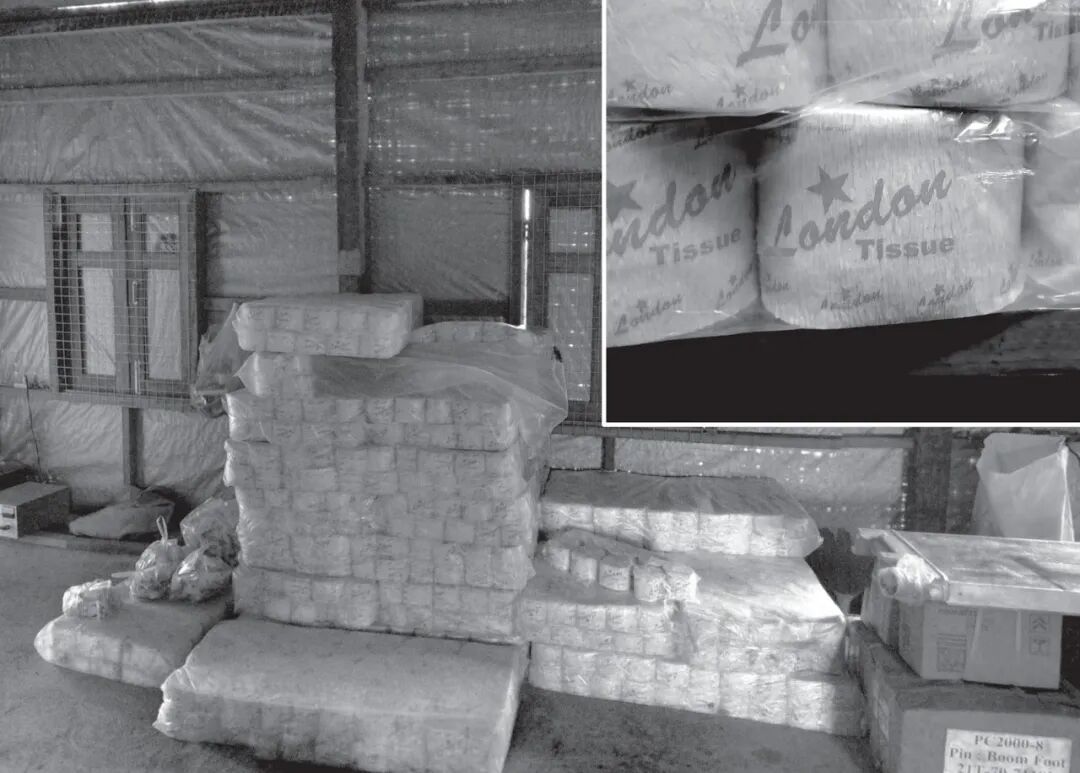
仓库里储藏量最多的货品是一种叫London tissue的卫生纸
还有另一种东西也架子上成堆:头戴灯。
The most abundantly stocked item in the warehouse is a type of toilet paper called London Tissue.
Another item stacked in large quantities on the shelves: headlamps.
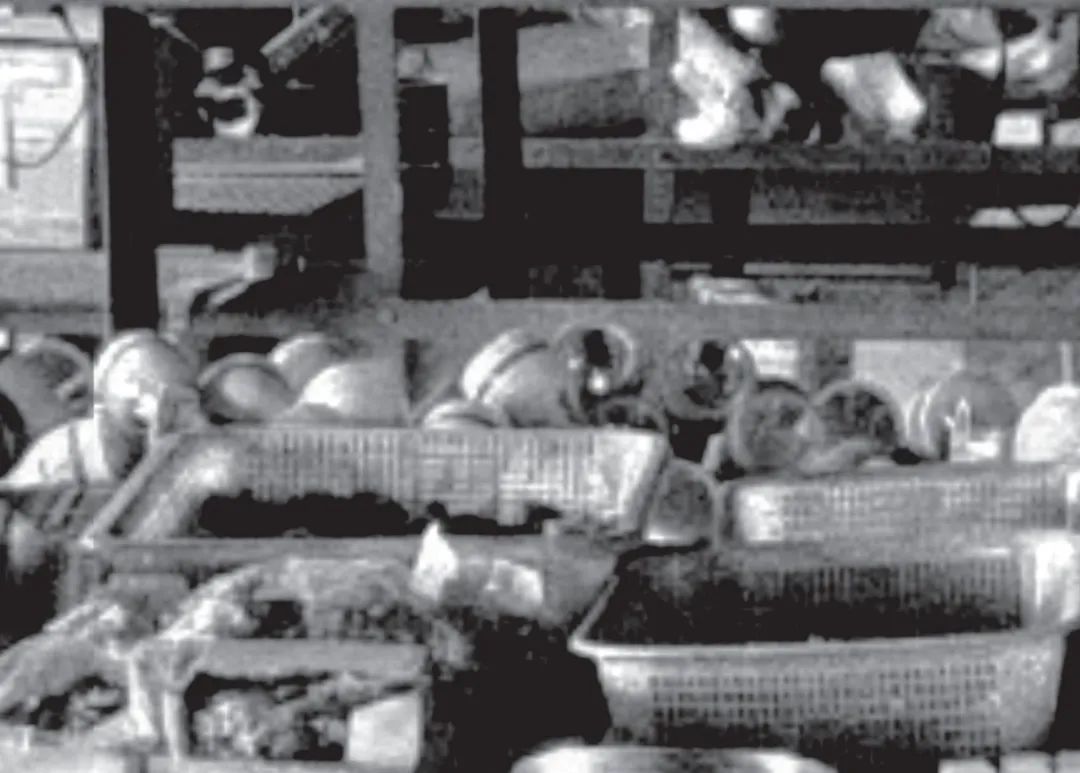
曾在一个翡翠商人的视频里看到,为了避开白天的高温天气,夜间的矿区也非常繁忙。因为贩卖短期的挖矿许可,和不稳定的政治局势,都让每一个获得采矿证的的公司用极度危险的方式挖掘,尽可能在短时间内挖最多的矿。
I once saw in a jade trader’s video that, to avoid the extreme daytime heat, the mining areas are just as busy at night. Because of the short-term mining permits being sold and the unstable political situation, every company with a license digs in extremely dangerous ways—trying to extract as much jade as possible in the shortest amount of time.
4,从曼德勒来的车
4 . Vehicles from Mandalay
在矿区上传街景图片的人不多,矿坑的边缘有人上传了三组照片。两辆车的车牌为MDL开头,这是曼德勒Madeley的缩写。
据说曼德勒有很多华人和缅甸最大的翡翠市场,出现在矿区一点都不意外。
Very few people upload Street View images in the mining areas, but along the edge of the pit, someone uploaded three sets of photos. Two of the vehicles have license plates starting with MDL—the abbreviation for Mandalay.
It’s said that Mandalay has a large Chinese population and is home to Myanmar’s biggest jade market, so its presence in the mining zone comes as no surprise.
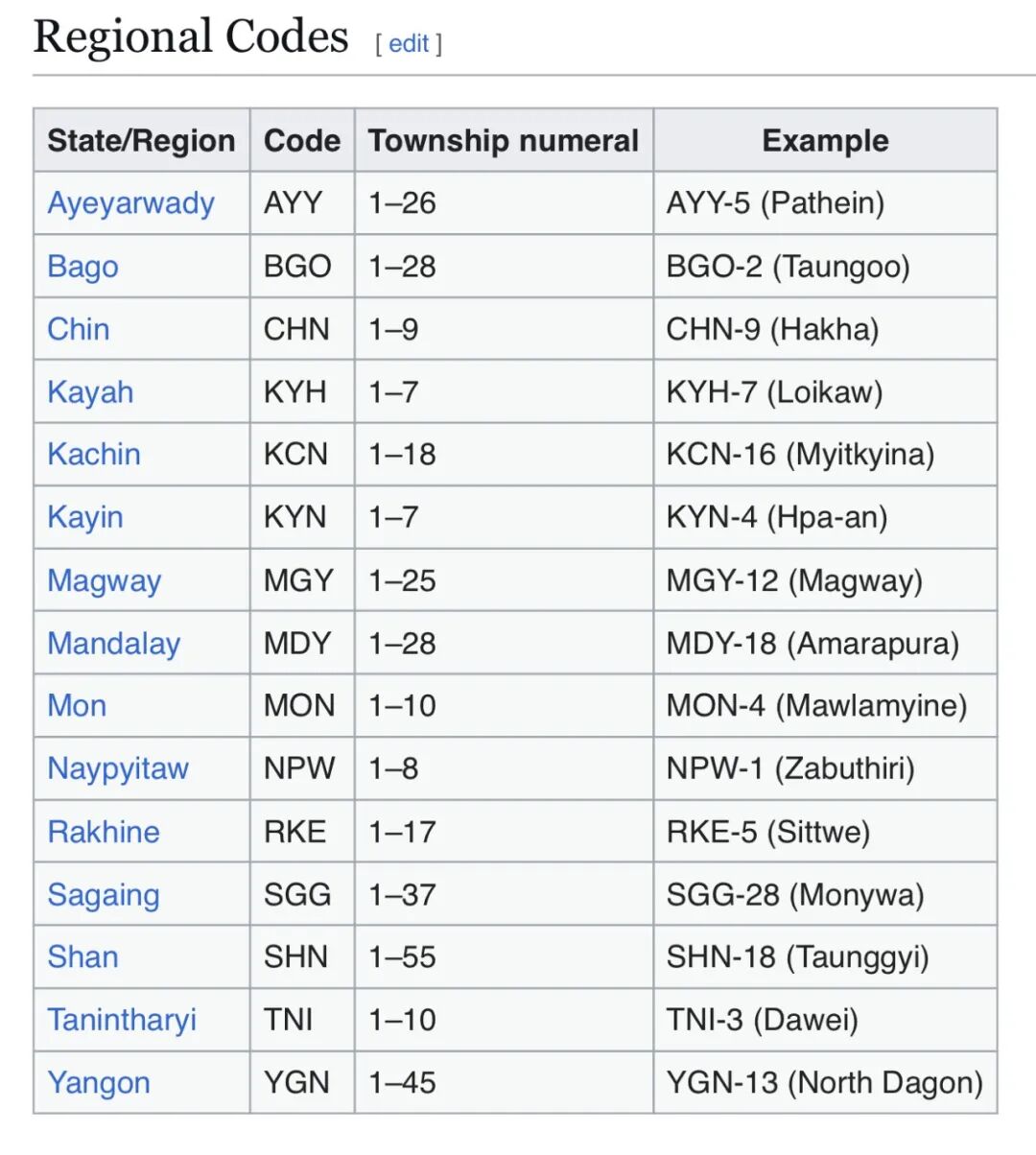
Caption: From Wikipedia — regional codes on Myanmar license plates
III, 结尾:最大限度地分解和最大程度地保持模糊
III. The End: Maximum Disassembly and Maximum Ambiguity
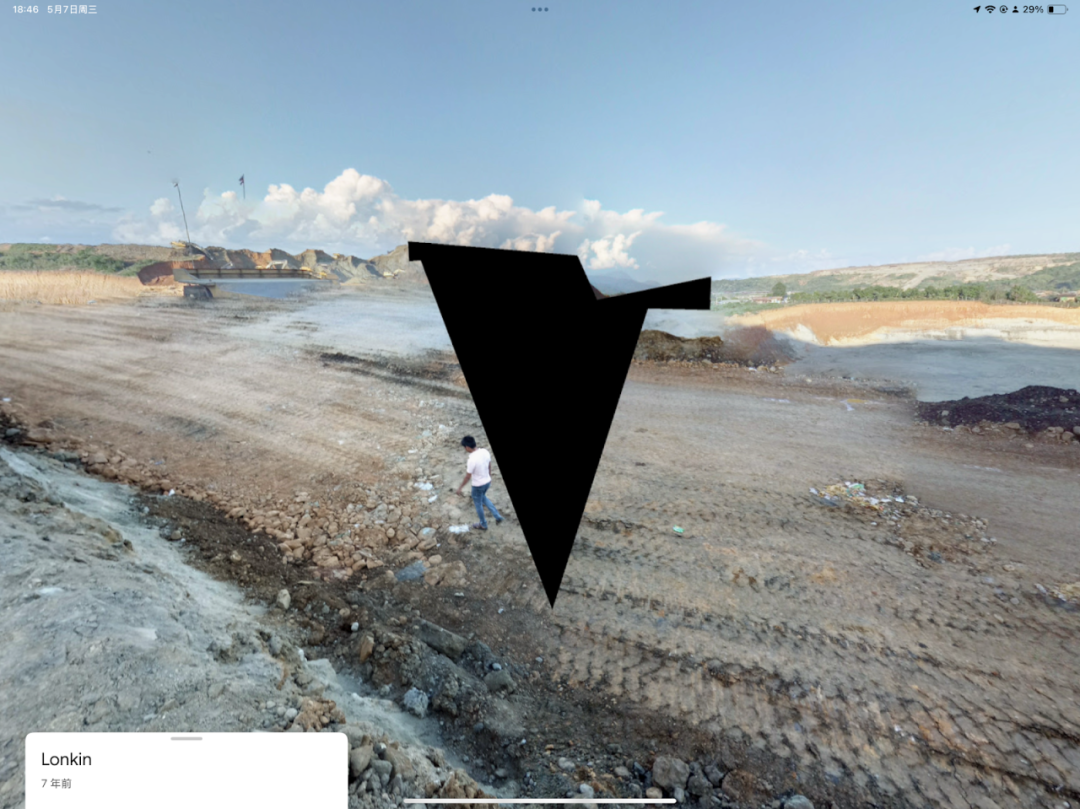
Google earth里的街景模式里,360度的全景图常常会看到拼接图片的漏洞,这个矿区的漏洞我看了很久,似乎是我这次翻刨各种信息找到的最好的一个东西似的。
2021年2月1日缅甸国防军发动政变以后,修理师在他主要使用的社交平台上表达了自己对军人的不满。
我摘抄了这则po文使用的hashtag:
#SaveMyanmar
这个帖子下面唯一的回复是:“修好你自己的东西/fix your own stuff” 。
In Google Earth’s Street View mode, the 360-degree panoramas often reveal stitching flaws. I stared at the glitch in this mining area for a long time—it felt like the best thing I had unearthed in this whole process.
After the military coup launched by the Tatmadaw on February 1, 2021, the repairman voiced his dissatisfaction with the military on his main social media platform.
I copied the hashtags he used in that post:
#SaveMyanmar
The only comment under the post was: “Fix your own stuff.”
作者:Jing
Author: Jing
《Map Writing · 牵挂的经纬》
这是一个从缅甸地图出发的写作专栏,源自《交错带》于春季发起的两场地图写作工作坊。 作品大多游走于真实与虚构之间,采用诗、散文、图片、街景轨迹影像等多种形式。参与者在虚拟街景中寻找那些因地震而刺入心头的图像与词汇,为无法抵达之地赋予感知与意义。 愿我们在遥望中同行。